
Mortgage Class Actions
Riar Ceartais run a programme of GDPR class actions concerning unlawful transfer of mortgages to third parties like vulture funds.
Why Are Mortgage Transfers Unlawful?
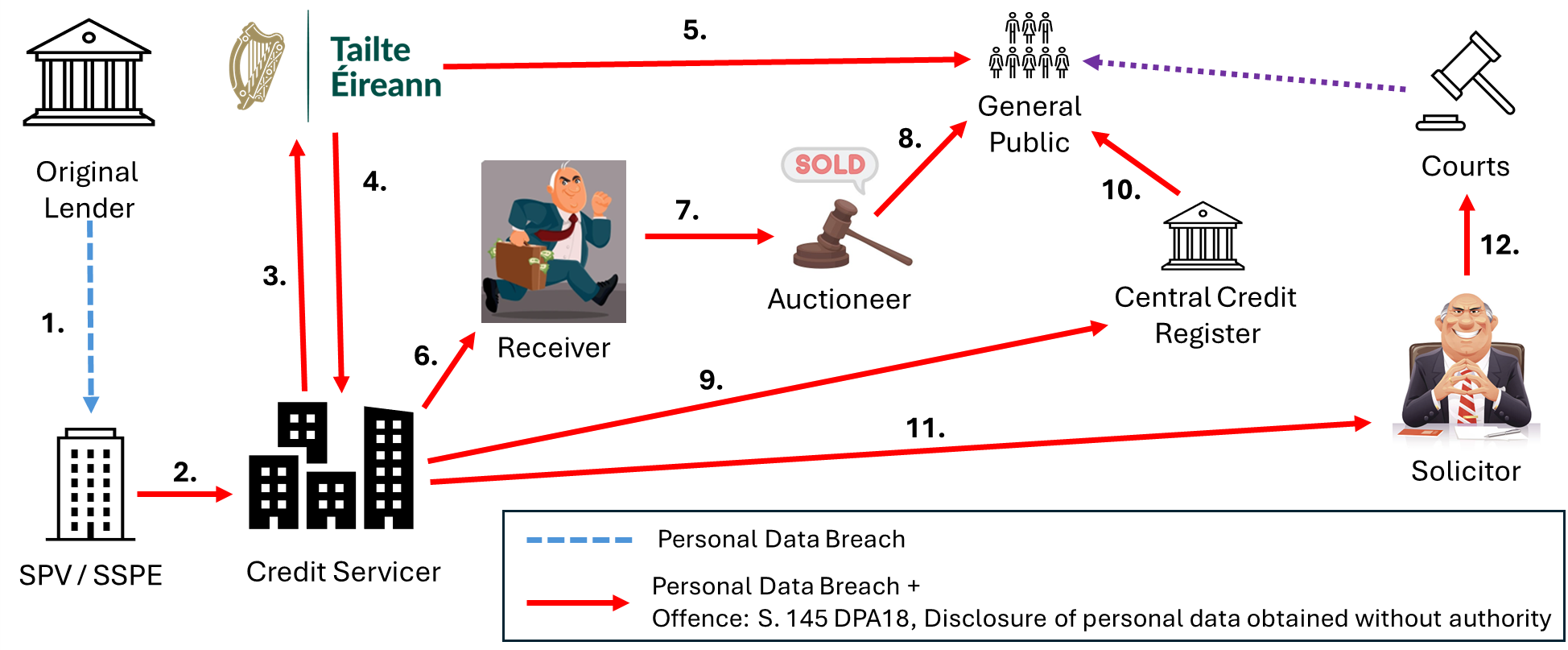
Put simply, Article 6(1) and Article 7(4) of the GDPR place legal obligations on lenders to obtain a borrower’s freely given, informed consent to transfer their mortgage to a third party. This applies even if a mortgage agreement contains terms and conditions which claim to permit transfer of the mortgage to a third party. As depicted in the diagram below, not only does a lender’s failure to obtain a borrower’s freely given, informed consent make the transfer of their mortgage unlawful in contravention of Article 6(1) GDPR, but all subsequent processing of information relating to the mortgage following its transfer is unlawful.
What Does Unlawful Processing Mean?
In short, the unlawful transfer of a borrower’s mortgage means credit servicers like Mars Capital Finance Ireland, Pepper Finance Corporation and Everyday Finance have no lawful Article 6(1) GDPR authority to do anything with a mortgage such as to
- demand mortgage payments,
- demand mortgage interest payments,
- submit credit reports to the Central Credit Register,
- lodge papers with Tailte Éireann to change property or charge ownership records relating to a mortgaged property,
- instruct solicitors to bring possession proceedings for a mortgaged property,
- appoint a receiver over a mortgaged property,
- take possession of a mortgaged property,
- appoint an auctioneer to sell a mortgaged property,
- etc.
Human Impact
The unlawful transfer of mortgages to third parties inflict considerable pain, suffering, distress, ill health, financial loss, reputational damage and other significant economic and social disadvantages on borrowers which are so severe that victims commit suicide with others contemplating suicide. Far too often unlawful mortgage transfers inflict generational trauma on victims’ children and grandchildren that severely interfere with the child’s development and deny children access to vital services such as education, health care, disability facilities, disability services, etc.
To put the human impact in context, many victims of unlawful mortgage transfers simply need a mortgage arrears repayment plan which genuinely works for their financial situation. However, that is impossible when vulture funds protected by a captive Central Bank of Ireland, for example, unfairly extort 7% to 10% mortgage interest rates from victims.
Class Action Objectives
Riar Ceartais have two high level GDPR class action objectives.
- To, in effect, injunct vulture funds, their credit servicers, servants or agents from doing anything with mortgages and property of class action members whose mortgages were unlawfully transferred.
- To recover compensation for material and non-material damages suffered by class action members whose mortgages were unlawfully transferred.
Potential Compensation
It is impossible to speculate with any degree of certainty what compensation, if any, victims may recover until the class actions have been dealt with at trial. But to venture an unqualified opinion, it is reasonable to believe that victims may recover compensation for property sold following the unlawful transfer of their mortgage.
Recital 75 GDPR clarifies that controllers must protect people from risk of damage to their reputation. Consequently, it is reasonable to believe that victims may recover significant compensation for the very serious reputational damage they suffer where controllers deliberately and intentionally process a mortgage victim’s personal data in a very high-profile public manner without any valid Article 6(1) GDPR legal basis enabling the controller to lawfully process that data in that manner.
For example, based on the Supreme Court guidance on compensation for reputational damages depicted in the accompanying diagram, a reasonable person may agree that victims suffer ‘very serious‘ “Level 4” reputational damages when, without a valid Article 6(1) GDPR legal basis to do so,
- credit servicers submit reputationally damaging credit rating reports to the Central Credit Register (“CCR”),
- solicitors acting for a credit servicer or receiver process a victim’s personal data before a public court,
- auctioneers advertise a victim’s property for sale on the internet.
The following is a finger in the air estimate for a single unlawful mortgage transfer victim with an average residential home valued at €390k. Following forced court proceedings and public online auction of their home, such a victim could potentially seek to recover €990k – €1.29m. This breaks down as follows:
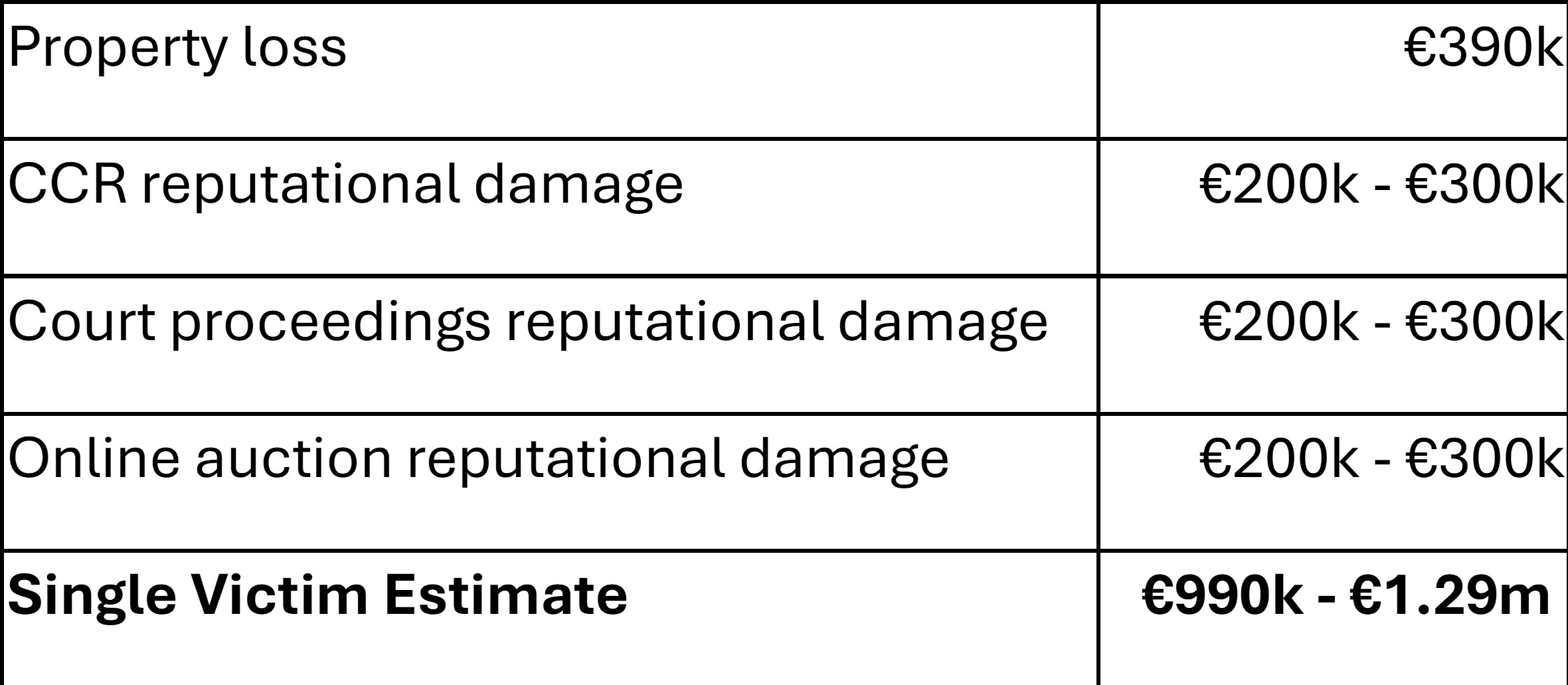
Reputational damages for a married couple in the same situation could potentially double to €1.2m – €1.8m (i.e., €200k to €300k x 2). Including €390k compensation for the loss of their home, such a couple could potentially expect €1,590 – €2.19m compensation.
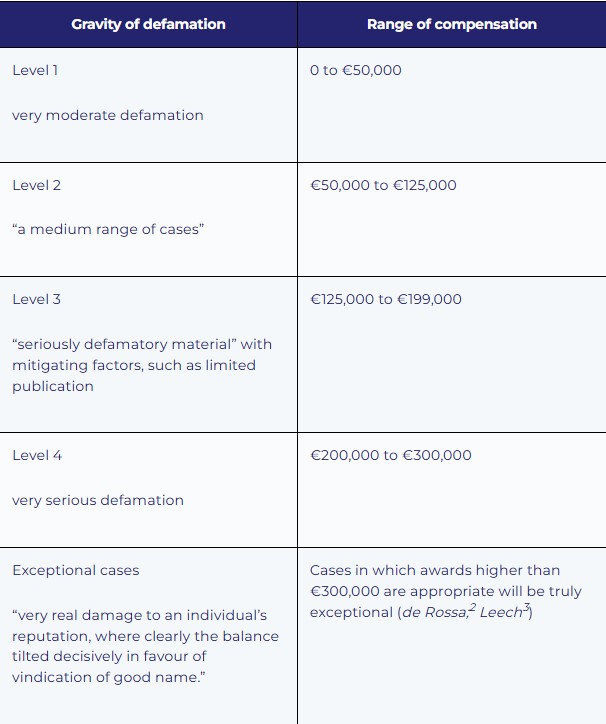
Supreme Court guidance on compensation for reputational damages in the matter of Higgins v The Irish Aviation Authority [2022] IESC 13.
However, those finger in the air estimates are only based on property loss and reputational damage estimates and do not consider other damages a victim may suffer in their particular situation. For example, the estimates don’t include damages suffered by a victim’s family like where children are denied access to vital services or suffer very serious reputational damage and traumatic bullying at school when made homeless. Nor do the estimates include damages victims suffer when charged extortionate interest rates of 6% to 10% (or more) after a mortgage transfer. The mortgage class actions can seek to recover compensation for all such damages.
Can Anyone Join?
To qualify to join an unlawful mortgage transfer class action your mortgage must be in your personal name (i.e., not in a company name) and must have been transferred to a third party (e.g., a vulture fund) at least once after 25th May 2018.
How Can I Join?
Anyone wishing to apply to join an unlawful mortgage transfer class action can complete the online application form.
What Does Joining Cost?
Legal costs associated with a GDPR class action are not so different to normal High Court legal proceedings. However, the big benefit from membership of a class action is that the legal costs are shared amongst the class action members. To put that in context members of the mortgage class actions can expect to contribute €1k to €2k per year towards the legal costs as against potentially facing hundreds of thousands of euro for taking a similar case on their own. Obviously the more members in the class action the less an individual member will pay. As Riar Ceartais estimate that over 340,000 mortgages have been unlawfully transferred affecting almost 500,000 victims, we expect the annual legal fee contribution per member could potentially drop to just a few hundred euro (or less) per member per year.
But as you may appreciate, the administrative overhead for managing a class action consisting of hundreds, or perhaps shortly thousands or tens of thousands of members is a considerable.
For example, even though the online application form is relative short and straight forward, the Riar Ceartais back-office application review and due diligence is considerable and can sometimes take four or more hours to process each application. To help manage the onboarding workload Riar Ceartais has engaged ‘onboarding assistants’ to help applicants through the application process. 10% (€123.00) is deducted from an applicants first year €1,230 legal fees’ contribution to pay for the onboarding assistant’s time and help.
Direct application expenses incurred while onboarding a new application are covered by charging a non-refundable €24.60 application fee. This helps cover application due diligence costs like purchasing Land Registry folio’s, conducting Registry of Deed’s searches etc. as well as other direct application expenses such as printing, postage, etc.
Ongoing Riar Ceartais expenses are covered by charging class action member’s a monthly €24.60 administration fee. This helps cover basic costs like IT, accountancy fees, insurance etc. As membership of the class actions grow Riar Ceartais hope to reduce the monthly administration fee.
Class Action Costs
- €1,230 annual legal fees contribution (10% paid up front as part of the initial application fee – €123),
- €172.20 non-refundable application fee (includes the €123 onboarding assistant deduction, €24.60 application fee and first months €24.60 administration fee).
- €24.60 ongoing monthly Riar Ceartais administration fee to cover the class action administrative costs.
Members can spread payment of the €1,107 (€1,230 – €123= €1,107) legal fees contribution over
- A single payment of €1,107,
- Over two monthly payments of €553.50,
- Over three monthly payments of €369.00, or
- Over four monthly payments of €276.75.
Transparent Description Of Costs
€172.20 application fee breaks down as:
- €123 (10% of the €1,230 annual legal fees contribution to pay for the onboarding assistant),
- €24.60 registration fee (to cover direct application expenses), and
- €24.60 first month of the monthly Riar Ceartais administration fee.
€1,230 annual legal fees contribution
As it was difficult to estimate the initial number of members, and consequently the legal fees’ contribution per member, the initial class action members voted and agreed to contribute €1,230 per year to cover the direct class action legal costs. The legal fee’s contribution is reviewed annually based on the number of members; the more class action members the lower the annual legal fee contribution will be.
€123.00 onboarding assistant payment (deducted from the first €1,230 payment)
It is important to note that Riar Ceartais is a true not-for-profit which means 100% of a member’s €1,230 annual legal fees contribution goes to pay for the direct class action legal costs; in fact, the Riar Ceartais Teoranta Constitution explicitly prohibits using any part of a member’s payment for anything other than direct legal costs without the member’s explicit written consent. For example, members provide their consent for Riar Ceartais to deduct the €123.00 (10%) from their first year legal fees’ contribution to pay the onboarding assistant who helps them to process their application.
€24.60 one off Class Action registration fee
Because Riar Ceartais is a not-for-profit with no income of its own to cover its operational costs, Riar Ceartais charge a €24.60 non-refundable registration fee to cover the direct costs incurred when onboarding a new applicant. For example, costs related to purchasing Land Registry folio’s, conducting Registry of Deed’s searches, printing, postage, etc.
€24.60 monthly Riar Ceartais admininistration fee
Again as Riar Ceartais is a not-for-profit with no income of its own, Riar Ceartais charge each member €24.60 per month to cover its operational costs. Members can select to pay this monthly or as a single annual fee.
Family Class Action Costs
Riar Ceartais believe it would be inherently unfair if each class action member in a family had to pay each of the class action costs. To address this, each family application is treated as a single member for the purpose of charging them. For example, a married or civil partnership couple only pay one annual legal fees’ contribution, one application fee and one monthly Riar Ceartais administration fee.
Where Can I Learn More About The GDPR Issues?
To help keep this introduction to the mortgage class actions as easy to understand as possible only a portion of the GDPR legal issues are summarised here.
To help people and organisations learn more about GDPR, Riar Ceartais has published the first six lessons of its GDPR Essentials training course. The training course videos can be accessed here.
To learn more about the GDPR legal issues concerning the unlawful transfer of mortgages. this 12/11/2025 letter to the Chair of the S&P Global Board of Directors is a useful reference as it also attaches a collection of correspondence to/from Tailte Éireann, the Central Bank of Ireland and Irish Ministers for Finance. However, the legal points in the correspondence is perhaps easiest understood after first watching the GDPR Essentials training course videos.
Class Action Defendants
A key requirement of any class action is that members of the class match the specific defendants responsible for causing the damage that a specific person has suffered. For example, as most members of the mortgage class actions are effected by Tailte Éireann and the Central Bank of Ireland’s processing of their personal data, those victims will likely join the class action against Tailte Éireann and the separate class action against the Central Bank of Ireland.
On the other hand, membership of the unlawful mortgage transfer class actions taken against specific credit servicers, receivers, auctioneers or solicitors is limited to people affected by those controllers. For example, only people whose mortgages were transferred to Mars will join the Mars class actions. Membership of the BidX1 auction house class action is limited to victims whose property was unlawfully sold (or is being sold) byBidX1, etc.
To date four GDPR unlawful mortgage class action’s have issued against
- Tailte Éireann,
- The Central Bank of Ireland,
- Real Estate Alliance auctioneers, and
- O’Donnellan & Joyce auctioneers.
However Riar Ceartais has established a programme of GDPR unlawful mortgage transfer class actions targeting all key stakeholders involved in the Irish unlawful mortgage transfer ecosystem.
Does it cost more to join multiple unlawful mortgage transfer class actions?
No, the costs outlined above entitle victims to join all of the applicable unlawful mortgage transfer class actions.